isole e olena
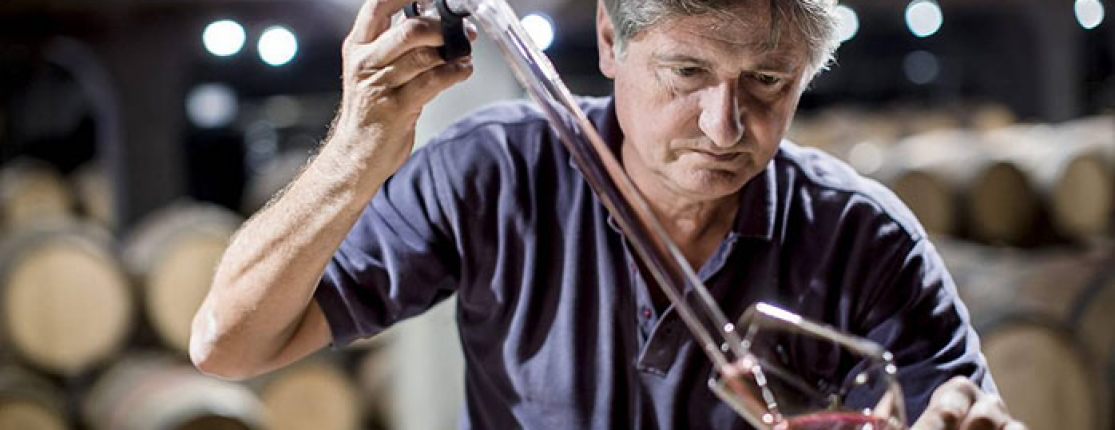
Paolo De Marchi - founder & winemaker
Barberino Val d’Elsa
Chianti classico - Tuscany - Italy
story…
The history of Isole e Olena is really the history of Paolo De Marchi. The estate was purchased by Paolo’s parents in the 50’s, in fact it was two separate, adjoining estates/commnes “Isole” and “Olena” each having long histories in the region as being home to grape production for wine. The De Marchi family roots lie in Piedmont where they have held a family wine estate in the Alto Piemonte, Proprietà Sperino, for several generations. Today Paolo’s son, Luca, runs that estate, making him a fifth generation winemaker, Paolo being the fourth. Paolo’s parents move to purchase an estate in Tuscany in the 50’s was rare, specifically for people in the wine industry who were mostly giving up their rural lives in Piedmont to move to the city and work in factories. His father was a lawyer, and never actually made wine even though it was a family tradition. The Isole e Olena estate and surrounding vineyards are based in the center of Chianti Classico, just north of Castellina, directly between Siena to the south and Florence to the north. Paolo made his way to the family estate in 1976, when he took full controll of the vineyards and production. Prior to his involvement at the family winery he studied Agriculture at the University of Turin and worked several harvests in both California and France.
Once he arrived at the estate it was quite clear to him that it was in need of some updates. His father had received subsidies from the EU to make the vineyard work, harvesting and winemaking easier and more focused on high yields. At first he continued to produce the wines as it was dictated to do under the consorzio of Chianti Classico. All the while improving the work in the vineyards and in the cellar to cleaner practices. Paolo has spent nearly two decades replanting the vineyards with increased density to increase the quality of the fruit produced, as well as restoring the ancient terraces in the vineyards, that had been removed to allow tractor friendly work to be done. Paolo has locally been coined “Mr. Sangiovese” referring to his dedication to this variety as being capable of producing a world class wine all on its own. Historically in Chianti Classico Sangiovese had to be blended with other varieties, at one point in history it had to include some white varieties and other red in order to be qualified as Chianti Classico. Many did not believe that Sangiovese could hold its own, which is why the requirement for other varieties existed.
From this passion and belief in Sangiovese as one of the great winemaking grapes, Paolo created his flagship wine “Cepparello”in 1980. A 100% Sangiovese wine that is aged in barrique, this wine rocketed him & the estate to success and made him only the second person in history to bottle a 100% Sangiovese wine in Chianti Classico (the first was “Le Pergole Torte” from Montevertine). The wine set a new standard for what was possible from Sangiovese in the hills of Chianti Classico, and to this day Cepparello remains a benchmark wine and one of the great wines of the world, not just Italy.
farming & Philosophy…
All farming is done with organic practices and has been since the beginning. Although Paolo is not interested in being certified organic he has never used any chemical herbicides or pesticides in the vineyards, the only sprays that are used are those that fall under the organic viticulture regulations. Over the years Paolo has continued to observe and respect that importance of the balance of life in the vineyards, seeing how beneficial it is to have healthy living soils with a combination of insects, animals and plants.
Paolo’s work in the cellar falls both in the “modern” camp and the “traditionalist” camp. Not one to adhere to any specific regiment or mindset, he has slowly formed a vinification & aging practice that he finds best suits his grapes from his vines. Fermentations are carried out with indigenous yeasts and most are fermented in stainless steel tanks, however some do go through part or all of the fermentation is barrel. All of the wines age in oak for a period of time, he employs a fairly wide range of barrel sizes in the cellar; including barrique & botti ranging from 1200-4000L sizes. On top of this he also has a mix of both French and American oak, although French is the clear dominate oak in the cellar, American oak makes up less than 5% of what is in the cellar. His only white wine, a Chardonnay, is treated much like a classic Chardonnay from Burgundy would be. All of the wines are bottled and aged in bottle at the estate for at least a short period of time prior to release, the Chianti Classico & Chardonnay receive the shortest time in bottle prior to going to market, about 3-4 months. The rest of the line up are aged in bottle for anywhere from 12-48 months.
The bottling of Vin Santo del Chianti Classico is worth pointing out on its own, it is both the most traditional wine of the estate and perhaps one of the finest examples of Vin Santo in Tuscany. These wines are painstakingly laborious and time consuming on all counts; from the meticulous grape selection, to the drying process on traditional bamboo mats, to the long aging of the wine in oak & chestnut. The resulting wine is one worth the time and labor it entails to create.
Vineyards…
The estate vineyards take up just 45 hectares of the total 250 hectares of land under the estate’s holdings. The majority of the land is covered with old forests that surround the estate and help to regulate temperatures & increase the biodiversity of the estate and surround hillsides. The primary variety of the estate is, not surprisingly, Sangiovese. In fact Isole e Olena has become a bit of a nursery for Sangiovese, Paolo’s dedication to understanding this variety on a deeper level and how it grows in varied soil compositions, trellising, & exposures is second to none. He has spent decades tagging the best producing vines in his vineyards and then using cutting from those to plant new vines or replace old/dead vines. More recently he has begun to do the same with Canaiolo, a traditional blending variety that Paolo believes is ever more important to expressing what a true wine of Chianti Classico is.
Along with the traditional red varieties of Sangiovese & Canaiolo, Paolo also has small portions of Trebbiano Toscana & Malvasia Chianti which are used for the Vin Santo production. There are also a host of international varieties on the estate, including Cabernet Sauvignon, Chardonnay, Syrah, & Viognier. The Cabernet & Chardonnay are destined for single varietal wines under his “Collezione Privata” moniker. The Syrah, originally intended for blending in the Chianti Classico bottling and is used in very small portions in that bottling today, mostly goes into a bottling of its own and gets a touch of Viognier akin to a traditional Côte-Rôtie. The Syrah bottling is also labeled under the “Collezione Privata” moniker.